Reports had been filtering in throughout the summer of others in similar states, but none quite as distraught. Some claimed there was a backlash against so-called tedious reading. It was said those readers started drinking early and quit only upon reaching Part V. Others hoped to recapture the experience of Part IV by continual rereading and referencing, and thus were able to maintain employment and social obligations. The cases were pursued for a few weeks, but ultimately shelved when no further evidence surfaced.

As seen in The New Yorker!
Sunday, July 8, 2012
Part IV
Midsummer of 2012 a female between the ages of 30 and 35 finished Part IV, The Part About Crimes, of Bolano's masterwork 2666. The female was later identified as a member of the PBR Book Club, a local group of literary elitists with a penchant for Pabst Blue Ribbon, a popular beer by all accepted standards. The woman had long hair, but it was often kept up wrapped tightly in a bun, due to her training in the library arts or to give potential murders a better look at her neck, where the hyoid bone lies protecting her non-functioning thyroid. Perhaps it was a hormonal imbalance or just the gentle disappointment that comes with finishing a work of brilliance, whatever the cause the woman was found fully clothed, rocking back and forth mumbling "vaginally & anally raped, swabs, broom handles, it was those cousins, working girls never get a break," and perhaps most telling, "why, why did it end?"

Giuseppe Arcimboldo: The first Surrealist?
At least one character's name in 2666 has a deeper meaning than what appears on the surface. Who was Arcimboldo?
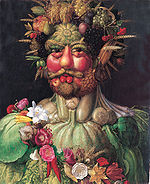
Vertumnus, Rudolph II Holy, Roman Emperor painted as the Roman God of the Seasons, 1590.
So why pick a Surrealist painter to pay homage to? It is a deliberate writing choice by Bolano to have one of his main characters change his last name from Reiter to a deviated version of Arcimboldo ( Reiter changes his name to Archimboldi).
On one level, the now dead Bolano gives us a wink when he uses Arcimboldo, suggesting that 2666 is surreal, not only in the many dreams and visions in the novel, but how we can read the novel like a dream. And, on another level, Bolano may be giving us insight into the nature of what we take from novels ( or any story telling device, even dreams). Rieter takes ideas from a notebook he finds and reads, such as this painter's name, and absorbs these ideas into his own life after altering them.
More about Arcimboldo
Although unrecognized as a great artist for many years since his death, the surrealists Dali and Magritte claimed Arcimboldo as one of their own, creating a place for him in art history. Man Ray recreated Arcimboldo's "Winter" and Alfred Barr, the founding director of the Museum of Modern Art, included Archimboldo in a 1936 show called "Fantasy in Art, Dada and Surrealism."

Arcimboldo's Winter
Man Ray was inspired by this painting (Seen below)


Magritte and Dali used objects for body parts, as seen here in a Magritte Suurealistic painting
Arcimboldo lived at a time when visual puns were highly regarded. The Surrealist-type paintings of Arcimbaldo show 16th century tastes: naturalism and the grotesque, as in the reversible paintings that are still-life that become faces when the panels are flipped upside down.

daVinci, Michelangelo and others like to make cartoon-like grotesques. Here we see da Vinci's drawing. Arcimboldo saw da Vinci's drawings.

drawing of Arcimboldo
See a slide show of Arcimboldo's work here: http://www.nytimes.com/slideshow/2007/10/09/arts/20071010_ARCI_SLIDESHOW_index.html?ref=design
Sources: http://www.nytimes.com/2010/09/24/arts/design/24arcimboldo.html
Tuesday, July 3, 2012
Books Within Books (Within Books?): Richard Writes About Reading in Bolano's 2666
[contains thoughts on Part IV but no major spoilers]
"Not reading, it might be said, was the highest expression of atheism or at least of atheism as he conceived of it. If you don't believe in God, how do you believe in a fucking book? he asked himself." --Bolano, 2666
From the opening sentence, 2666 announces itself as a book about the process of reading: "The first time that Jean-Claude Pelletier read Benno von Archimboldi was Christmas 1980, in Paris, when he was nineteen years old...". Part I, as I discussed in my last post, is almost entirely about reading, as the four Archimboldi critics create a new world of scholarship through their interpretations of Archimboldi. Also, although I'm struggling to locate good examples, Part I occasionally slips into a direct address to the reader: " 'Yes, of course,' said our four friends" (top of 106). That "our" incorporates the reader and calls attention to the artifice, something I haven't seen at all aside from Part I.
In Part II, the most fascinating book-centered issue is Amalfitano's mysterious geometry text (which he possesses with no memory of purchasing it). Naturally, he does what anyone would do with such a mystery text: he hangs it outside on a clothesline as an "experiment": "it's a Duchamp idea, leaving a geometry book hanging exposed to the elements to see if it learns something about real life." (195). Other reading-related issues of Part II concern letters from Amalfitano's wife, as well as a frustratingly long section where good old Amalfie reads passages from a tome about "Araucanian telepathy."
In Part III, Fate, a writer, heads to Mexico where he listens to an ex-prisoner give a five point lecture about "DANGER. MONEY. FOOD. STARS. USEFULNESS," the latter focusing specifically on the "usefulness" of a book called (amusingly) "An Abridged Digest of the Complete Works of Voltaire." Part II also contains my favorite fictional book title so far: Eating Ribs with Barry Seaman. Fate, like Amalfitano, also spends sections of Part III reading a book. In this case, it's The Slave Trade, which he was given (a gift from the last communist in Brooklyn!) prior to hearing Seaman's lecture The Communist hands him the book along with this advice "Son, I'm going to give you a book that will be of great use to you" (260).
Part IV, or as I call it, The Rape Section, contains the quote used above to open this blog post. There's also a reading devotee in this section, the young policeman Lalo Cura (though I'm not sure his constant reading of outdated crime manuals is going to help him solve these rapes and murders. I hope I'm wrong!). And of course there's the most notable (and, to me, infuriating) aspect of Part IV, the technical "crime-scene" / forensic documentation style of the murder victim sections. Is this meant to contrast wth a section in Part III, in which a "white-haired man" tells Fate about how 19th century writers wrote about death, in such a way "that you might get the idea that there was hardly any crime, or that a single murder could throw a whole country into tumult" (266). The man ends his reflection with these creepy and ambiguous lines about how the murders of society's outcasts were written about: "What happened to them could be written, you might say, it was legible. That said, words back then were mostly used in the art of avoidance, not of revelation. Maybe they revealed something, all the same way. I couldn't tell you" (267). There's no avoidance on Bolano's part in Part IV, however. He wants us to read about every rape and murder in Santa Teresa. So I will. But not without some grumbling.
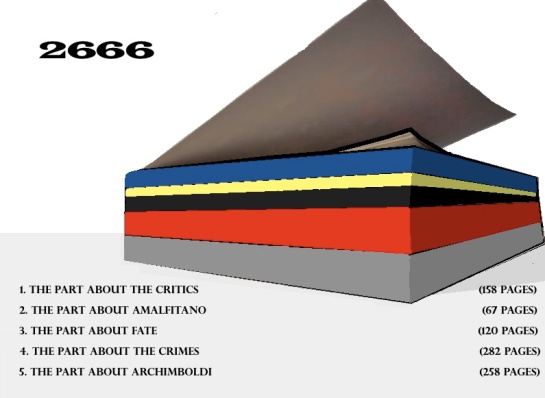
And here's an illustration of the page lengths of each section from a funny little website called Bullshit English Homework .
Monday, July 2, 2012
Karen tries to keep track of the characters

As I was trying to keep track of characters, I was happy to see someone named Brooks, who writes a blog for his book club, took the time to document the characters of "2666" for its members. It's also good to know that there are other people in book clubs that are also blogging about their books with the same nerdy diligence as members of our PBR Book Club.
Although his blog post is a work in progress, I am impressed with his organization, tenacity, and attention to detail, such as documenting historical people including poets and artists mentioned in Book one. He created a timeline for the first book, and has created a list of victims for the fourth book.
See here: https://docs.google.com/document/pub?id=1qby7k2nQeu7GDjgrlCEYPn3UDJ_V4gdmaGJOArPfDLs
I think I might just contact Brooks and let him know what a good job he did.


Wednesday, June 20, 2012
"It's Mathematically Imposible": Reading 2666 Out Loud
Hi everyone! It's taking me such a long time to read 2666 because there's something brilliant to share on every page. Taking a little time-out today to read you one of my favorite passages so far, from "The Part About Fate." Spoiler: it's about semen.
Friday, June 15, 2012
Castles & Globalization & Seaweed & Boxing & Baronesses & Creepy Dream Echoes
NO SPOILERS. CAN READ AT ANY STAGE.
If you're going to write a masterwork before you die, then I recommend writing "2666" like Roberto Bolaño did, which is a masterwork in the literary novel form or perhaps a mutation of the literary novel form which sprawls and spreads across time and continents and eroded academic insularities and the insanity of hopelessness and the humor of the human condition and that of society, which in Bolaño's view is at once fickle and heavily driven by Fate, or driven by Fate but also by a side infatuation with ancient mythology making just as much sense as any sort of reason or meaning or perhaps equity in the modern or really the post-industrial world with fondness or idyllic and bucolic historical scenes as childhood and anachronistic remembrances where love exists not so much moment by moment and in fact might come off as quaint if you did sense it there but rather it ultimately exists in the grand sweep, the aggregation of our steps and strides as we either engage life with passion and intent or while and idle away the time with poor imitations of the real thing, indeed, as it might even be said that as we die by principle or live by compromising our principles or really our deep-seated morals but actually or quite possibly our accumulated human ethical baggage or perhaps trappings and traces of our circumstances and likes and dislikes, not to demean the color and consistency of personality or attitude or naively opinionated egos which seem to rival Providence in their drive to autonomy but a view of humor which at any rate can be illustrated by such compound backhanded levity as quotes like this one from a setting where so-called "vanished writers" (who, are, generally speaking, writers once known or lauded or even perhaps with a readership of some significance or at least a readership but for whatever reasons have faded from public view or were not smiled upon kindly by the whims of the larger arcs of history despite for the most part having been good and worthy writers overall with good ratings and fan appeal behind the eyelids of a dreaming great uncle from one of the World Wars) gather to live in serenity and quiet or relatively quiet and mild disharmony in the woods outside a smallish town somewhere in a countryside, part bed and breakfast, part retirement community in look and feel but (without me revealing the specifics in the context of the actual work despite the fact that in the actual work the settings aren't actually overly specific) where in this case the narrator describes a protagonist as coming down a hallway while wandering after dinner to a gym or a massage room, or a kind of a work-out room really, with a few people found there, whereupon the narrator proceeds to inform the reader that "The weight lifter seemed to be an employee and the old man in pajamas looked less like a vanished novelist than like a justly forgotten novelist, the typical hard-luck bad French novelist, most likely born at the wrong time" which is typical of Bolaño in conjuring for us an internal or mentally-visceral experience (not really visceral in the intestinal sense but in the dizzying sense of being inside an actual mind with its vast and convoluted flows and halts and genius and stupidity) of how perception and thought and image chase each others' tails in a continually unfolding sequence of discoveries, assumptions, judgements and surprises whether he is zoomed in on a given scene or reverie or voiced reverie that is sometimes more a soliloquy or really just a monologue in some cases which he achieves by such sure-handed and risky flows that weave mild surrealism with dream intuition and glimpses of insanity and unpredictable actions of treachery and forthrightness not to mention unabashedly real and complicated sexual and power dynamics that are themselves a blend of horror, animalism, tenderness, discovery and habit (not to mention a memorable penis of historic or actually even epic proportions at the junction where physical possibility and myth begin to blur like the edges of a fleeting voyeuristic moment) so that they take on a hyper-realism or a fairy-tale-tryst-in-the-woods nuance or an emotionless empty act that still involves a hint or a reflection in a dusty or really a grimy windowpane of love or something like love or possibly a sense of commitment or at least a momentary surge in caring while struggling to care or commit or love, or whether he is zoomed out in both time and narrative, far from the minutiae of the moment, both and all of them all at once as a microcosm of the layers of echoes across the five books that pit signification or representation or resemblance versus something that seems decidedly more real, solid frameworks no matter the cost versus cowardice and survival, randomness versus meaning, and beating the crap out of a taxi driver versus diving for seaweed at the risk of drowning, and such a work is a brilliant, engaging experience precisely because it works sentence by sentence, paragraph by paragraph, turn by turn, striding, climbing, floating, acting with intent, giving up, obsessing, searching, dreaming, giving up once again until abstract and seemingly foolish sentimentalities like love and compassion as well as the ostensibly cruel indifference of the universe when it looks the other way at the wrong moments do exist at some higher order level as when hiking endlessly up a mountain path through the trees for hours in the flying, biting insects and forest-contained humidity only to emerge at the timberline to a cool breeze coming off nearby snowy peaks and alpine meadows with tiny flowers and gurgling water and a small brown furry mammal you've never seen before peering at you from behind a rock or actually several of them behind many different rocky outcroppings all watching you and possibly they are called marmots and then you turn and behold the breathtaking panorama below, the starting point of your odyssey so tiny and distant and in fact only remembered and not directly glimpsed as it is now obscured by having traversed so many changes in terrain since then and so therefore one is left to ponder on which scale, on which magnitude are these experiences real and on which are they imagined, filtered, dreaded or desired into virtual existence or even into a coveted pseudo-actuality until some other more substantial reality collides directly enough to shatter the illusion or at least rudely shove it aside or perhaps act friendly enough, plying it with drink and hospitality sufficiently to escort it to a safe, out-of-the-way place where it can be held comfortably out of the way or perhaps gently put out of its misery though in actuality just disposed of incompetently but disposed of nonetheless and those that come along later can never really piece together the vitality of what came before them any more than colorizing old black and white photos can allow the viewer to understand the faces peering back from the faded print now further removed from the ability to grasp such a thing under the unblinking proliferation of immediate camera effects and Instagram-like trinkets to pretend that something so temporally in the now feels like it has some sort of actual weight of history to it when really what has more weight despite just being electromagnetic waves in your cerebral cortex at the dead of night is a dream involving mirrors and yourself viewed from behind and in between the mirrors, the figure of your curiosity slowly turning until your mutual gaze must inevitably intersect but it takes great effort for the figure to turn further and further and then it's not you after all that is turning toward you and you become terrified of the moment when the two gazes will meet eye to eye and the inexorable turning and flitting expressions of madness and then imagine that someone else has this exact dream! or one very like it or that they have a dream kind of like it or like a shadowy movement behind a curtain that causes them suddenly to recall the dream in a moment of unfocused distraction but it is in a physical locale that is uncomfortable and uncanny in its similarity to the room you had your nightmare in, and also: there are many secrets to life and moments where we get to be close to that secret in times of duress or in dreams or in those rare instants of epiphany that come at the most unpredictable moments which we then of course attempt to latch onto with endorphins and subtle justifiable craving and whispers of nostalgia but if you really want to penetrate a secret go to the desert and allow what is there in that endless boredom to penetrate what is inside of you and also: do this without a sense of later today or tomorrow or next week or really sometime soon but not right away or what you might imagine yourself to be like when you are legitimately elderly after a long, hard-lived life but rather do this with a sense of how it might appear to someone reading about you and your life and your good times and your good memories and your revulsion and regret and the best and worst of your behavior and decisions and dead reckoning and times of despair and of inspiration and of straight-up luck and of truly hard work and of fiascoes, failures and fate, reading about all of these things from say, six or seven hundred years from now, peering into the few faded and permanently degraded hues and inscrutable blotches that are to that reader but a semblance of every fertile femtosecond we have been sentient for or nearly sentient for or perhaps mostly dreaming of until startled.

If you're going to write a masterwork before you die, then I recommend writing "2666" like Roberto Bolaño did, which is a masterwork in the literary novel form or perhaps a mutation of the literary novel form which sprawls and spreads across time and continents and eroded academic insularities and the insanity of hopelessness and the humor of the human condition and that of society, which in Bolaño's view is at once fickle and heavily driven by Fate, or driven by Fate but also by a side infatuation with ancient mythology making just as much sense as any sort of reason or meaning or perhaps equity in the modern or really the post-industrial world with fondness or idyllic and bucolic historical scenes as childhood and anachronistic remembrances where love exists not so much moment by moment and in fact might come off as quaint if you did sense it there but rather it ultimately exists in the grand sweep, the aggregation of our steps and strides as we either engage life with passion and intent or while and idle away the time with poor imitations of the real thing, indeed, as it might even be said that as we die by principle or live by compromising our principles or really our deep-seated morals but actually or quite possibly our accumulated human ethical baggage or perhaps trappings and traces of our circumstances and likes and dislikes, not to demean the color and consistency of personality or attitude or naively opinionated egos which seem to rival Providence in their drive to autonomy but a view of humor which at any rate can be illustrated by such compound backhanded levity as quotes like this one from a setting where so-called "vanished writers" (who, are, generally speaking, writers once known or lauded or even perhaps with a readership of some significance or at least a readership but for whatever reasons have faded from public view or were not smiled upon kindly by the whims of the larger arcs of history despite for the most part having been good and worthy writers overall with good ratings and fan appeal behind the eyelids of a dreaming great uncle from one of the World Wars) gather to live in serenity and quiet or relatively quiet and mild disharmony in the woods outside a smallish town somewhere in a countryside, part bed and breakfast, part retirement community in look and feel but (without me revealing the specifics in the context of the actual work despite the fact that in the actual work the settings aren't actually overly specific) where in this case the narrator describes a protagonist as coming down a hallway while wandering after dinner to a gym or a massage room, or a kind of a work-out room really, with a few people found there, whereupon the narrator proceeds to inform the reader that "The weight lifter seemed to be an employee and the old man in pajamas looked less like a vanished novelist than like a justly forgotten novelist, the typical hard-luck bad French novelist, most likely born at the wrong time" which is typical of Bolaño in conjuring for us an internal or mentally-visceral experience (not really visceral in the intestinal sense but in the dizzying sense of being inside an actual mind with its vast and convoluted flows and halts and genius and stupidity) of how perception and thought and image chase each others' tails in a continually unfolding sequence of discoveries, assumptions, judgements and surprises whether he is zoomed in on a given scene or reverie or voiced reverie that is sometimes more a soliloquy or really just a monologue in some cases which he achieves by such sure-handed and risky flows that weave mild surrealism with dream intuition and glimpses of insanity and unpredictable actions of treachery and forthrightness not to mention unabashedly real and complicated sexual and power dynamics that are themselves a blend of horror, animalism, tenderness, discovery and habit (not to mention a memorable penis of historic or actually even epic proportions at the junction where physical possibility and myth begin to blur like the edges of a fleeting voyeuristic moment) so that they take on a hyper-realism or a fairy-tale-tryst-in-the-woods nuance or an emotionless empty act that still involves a hint or a reflection in a dusty or really a grimy windowpane of love or something like love or possibly a sense of commitment or at least a momentary surge in caring while struggling to care or commit or love, or whether he is zoomed out in both time and narrative, far from the minutiae of the moment, both and all of them all at once as a microcosm of the layers of echoes across the five books that pit signification or representation or resemblance versus something that seems decidedly more real, solid frameworks no matter the cost versus cowardice and survival, randomness versus meaning, and beating the crap out of a taxi driver versus diving for seaweed at the risk of drowning, and such a work is a brilliant, engaging experience precisely because it works sentence by sentence, paragraph by paragraph, turn by turn, striding, climbing, floating, acting with intent, giving up, obsessing, searching, dreaming, giving up once again until abstract and seemingly foolish sentimentalities like love and compassion as well as the ostensibly cruel indifference of the universe when it looks the other way at the wrong moments do exist at some higher order level as when hiking endlessly up a mountain path through the trees for hours in the flying, biting insects and forest-contained humidity only to emerge at the timberline to a cool breeze coming off nearby snowy peaks and alpine meadows with tiny flowers and gurgling water and a small brown furry mammal you've never seen before peering at you from behind a rock or actually several of them behind many different rocky outcroppings all watching you and possibly they are called marmots and then you turn and behold the breathtaking panorama below, the starting point of your odyssey so tiny and distant and in fact only remembered and not directly glimpsed as it is now obscured by having traversed so many changes in terrain since then and so therefore one is left to ponder on which scale, on which magnitude are these experiences real and on which are they imagined, filtered, dreaded or desired into virtual existence or even into a coveted pseudo-actuality until some other more substantial reality collides directly enough to shatter the illusion or at least rudely shove it aside or perhaps act friendly enough, plying it with drink and hospitality sufficiently to escort it to a safe, out-of-the-way place where it can be held comfortably out of the way or perhaps gently put out of its misery though in actuality just disposed of incompetently but disposed of nonetheless and those that come along later can never really piece together the vitality of what came before them any more than colorizing old black and white photos can allow the viewer to understand the faces peering back from the faded print now further removed from the ability to grasp such a thing under the unblinking proliferation of immediate camera effects and Instagram-like trinkets to pretend that something so temporally in the now feels like it has some sort of actual weight of history to it when really what has more weight despite just being electromagnetic waves in your cerebral cortex at the dead of night is a dream involving mirrors and yourself viewed from behind and in between the mirrors, the figure of your curiosity slowly turning until your mutual gaze must inevitably intersect but it takes great effort for the figure to turn further and further and then it's not you after all that is turning toward you and you become terrified of the moment when the two gazes will meet eye to eye and the inexorable turning and flitting expressions of madness and then imagine that someone else has this exact dream! or one very like it or that they have a dream kind of like it or like a shadowy movement behind a curtain that causes them suddenly to recall the dream in a moment of unfocused distraction but it is in a physical locale that is uncomfortable and uncanny in its similarity to the room you had your nightmare in, and also: there are many secrets to life and moments where we get to be close to that secret in times of duress or in dreams or in those rare instants of epiphany that come at the most unpredictable moments which we then of course attempt to latch onto with endorphins and subtle justifiable craving and whispers of nostalgia but if you really want to penetrate a secret go to the desert and allow what is there in that endless boredom to penetrate what is inside of you and also: do this without a sense of later today or tomorrow or next week or really sometime soon but not right away or what you might imagine yourself to be like when you are legitimately elderly after a long, hard-lived life but rather do this with a sense of how it might appear to someone reading about you and your life and your good times and your good memories and your revulsion and regret and the best and worst of your behavior and decisions and dead reckoning and times of despair and of inspiration and of straight-up luck and of truly hard work and of fiascoes, failures and fate, reading about all of these things from say, six or seven hundred years from now, peering into the few faded and permanently degraded hues and inscrutable blotches that are to that reader but a semblance of every fertile femtosecond we have been sentient for or nearly sentient for or perhaps mostly dreaming of until startled.

June Meetup
Hello, hipsters,
We'll be meeting to discuss 2666: parts 1-3 at Frank's North Star Tavern on Tuesday, June 26th, 8:00 pm. Why Tuesday? For the $2 tall boys, obviously (you're welcome).
No spoilers, or you will be slain. Game of Thrones style. No joke.
We'll be meeting to discuss 2666: parts 1-3 at Frank's North Star Tavern on Tuesday, June 26th, 8:00 pm. Why Tuesday? For the $2 tall boys, obviously (you're welcome).
No spoilers, or you will be slain. Game of Thrones style. No joke.
Subscribe to:
Posts (Atom)