Friday, August 17, 2012

Richard Sings the Praises of the Nutsack (to the tune of Billy Joel's Movin' Out).


So far the anti-Nutsack contingent is not airing their grievances on the blog, but I know they are out there, muttering into their PBR about the frustrating lack of plot in this "novel" and the infuriating monotony of the whole affair.  Fair enough, but I'd argue that, in many ways, those very elements make it perhaps the most fitting selection yet for the original "goals" of PBR Book Club: to read pompous, postmodern, meta, "difficult," works.

Courtneybelle's previous defense of the novel lists off various reasons that Nutsack may be rubbing its readers the wrong way, among them the fact that it _might_ be delivering religious messages (of one sort or another) beneath its many layers of navel-gazing and outrageous vulgarity.  Maybe.  Though it seems to me that Leyner's central concerns are the central concerns of so many of our chosen books thus far (especially Cloud Atlas and 2666):  the role of reading and storytelling in our lives and interconnections of life and art.

Leyner is especially interested in the idea of the "epic," and we find out soon enough that The Sugar Frosted Nutsack is an orally transmitted, constantly evolving work recited by blind bards while swilling Sunkist (the official drink of the Nutsack).  The "hero" of this epic is Ike Karton, a "SUPER-SEXY" New Jersey butcher, but the story deliberately lacks all the narrative momentum, the "journey," that we expect from epics and instead becomes mired in constant "exegesis" (a favorite word of Leyner, it seems), as each new addition to the epic is constantly parsed, leading us further and further away from the original narrative.  One could potentially see Leyner's book as a critique of "theory," which leads us further and further away from the work itself, but of course that's complicated by the fact that Leyner seems to fully embrace every post-modern and meta trick in the book (complete with a wildly clever loophole that absolves the "author" of all the work's faults:  the most annoying and lewd sections are actually "interpolations" by the God XOXO, trying to sabotage the work).

So...do I find Nutsack annoying?  Yes.  Do I find it smart?  Yes. Ostentatiously so, but undeniably intelligent.  And, most importantly, is it funny? Well, I just laughed out loud numerous times during the "75 Sex Tips From the Gods" section.

Observation:

Surely our Nutsack meeting will offer many opportunities for participation, given the fact that it's meant to be performed as we down Sunkist while chanting "Ike, Ike, Ike" to ward away XOXO:

"But remember, when you chant "Ike, Ike, Ike, Ike, Ike" to fend off the spiteful interpretations of XOXO, it absolutely has to sound like Popeye laughing or like Billy Joel in 'Movin' Out (Anthony's Song),' or it won't work."

Another observation:  I'm certain than Mark Leyner is a lunatic.


Wednesday, August 15, 2012

Courtneybelle Embraces the Nutsack!


If You Don't Like This Book, It's Only Because XOXO Is Stealing Your Thoughts
                    
                   "These portions can seem hoplessly corrupt. 
                   XOXO is winning the battle to ruin the book, 
                   But he hasn't won the war."


I like books that don't take themselves seriously and books that seek to make the reader feel ridiculous. A book that disregards the reader's comfort has balls.

Mark Leyner has chosen to write about so many modern foibles that he is certain to alienate.  He's also chosen themes that scratch the paint off every reader's well-glossed self image. And he had the GALL to do it in a format as scattered and deluded as a PBS telethon. How dare he make us work so hard to like this book!?  The Sugar Frosted Nutsack has shown itself, in the majority, to be undigestible. Which leaves one to wonder, if this book is not for you, it might be about you.

REPETITION HAS A PLACE IN THIS WORLD

Yes, some dislike Nutsack's disrespectful use of repetition. Leyner's daring use of cut-and-paste forces the reader to absorb the same damn lines over and over. Hey, it works for poets and musicians. I choose to see it as a not-too-subtle illustration of the fact that we have each been a party to some mindless regurgitation or other. His use of repetition is frankly an insensitive reminder that, as we age, we build a myth about ourselves. Then we repeat that myth to maintain some calming certainty. Of course, Nutsack points out that myth is at best a half truth and probably a lie. 

I HATE TO SAY IT, BUT I THINK THIS BOOK MIGHT BE ABOUT RELIGION

No one wants that. That will put people right off. It doesn't even matter what an author has to say about religion, faith, or "spirituality". Positive or negative, the modern reader is sick to the teeth of hearing about personal growth by way of faith or how organized religion stifles individuality or whatever.  Jesus loves us? YES, WE KNOW! But for the love of beer, don't bring it up. Readers certainly don't want it suggested that God is laughing at them or, WORSE, that God thinks they're boring! If Nutsack does turn out to be some whimsical religious allegory, then that would explain the insulting repetition previously discussed. Religion is nothing without repetition. Yeah, yeah, Nutsack delivered up a crude but endearing pack of gods at the beginning. But how was the reader to imagine the author would have a serious message of any kind since his book began with drunken gods returning from spring break?

Clearly, that was all a clever ruse on the part of Leyner to trick us into reading about religion. What a dick move!  He lured us with the title: his promises of sweet, sweet testicles. Numbed our suspicious minds with fast-talking overuse of pop-culture references and an unlikely yarn about over-sexed street gang gods till we couldn't trust that there would be a serious word written in this book. Next thing we know, he'll casually write something like,"'noncanonical blooper." Then, BAM! We've accidentally read some joker's scathing yet quirky take on religion. For all we know, Nutsack will subtly suggest that we're not special.

YOU'RE NOT SPECIAL

This is a dangerous approach for an author. But, I have to say, Leyner tried to slip it in like a wayward  game of "just the tip". What can be said about our overly-sung hero, Ike, Ike, Ike, Ike! A legend in his own mind? A rebel without applause? Who knows. But if an unemployed butcher from Jersey has a devoted blind bard fanbase, then logically anyone could.  Ike is a perfect specimen of the self-centered American reality TV narrative that we are soaking in today. Everything is simultaneously true and false. Each of us has become the star of the movie in our mind. We have lost internal dialog. We've begun narrating our own lives to an invisible audience of blind bards! Those of us surviving the high water mark of social media are no more a hero than Ike. Nevertheless, odds are good  that our breakfast food is as well-publicized as his. Our whole society is based on the premise that we are all unique little snow flakes. Nutsack takes aim at the way we are building mythical selves and firmly wallowing in cultish self-obsession? What a cock!  Of course we expect our memory to be eternal. Each of us having written our own biography 140 characters at a time, how could we fail? Oh, it wasn't bad enough that it has turned out to be a book about religion, then Nutsack wants us to have a moment of honest perspective. Come ON!

MODERN HUMANS ARE ILLOGICAL AND SO IS THIS BOOK

Christians don't like to be reminded that they aren't supposed to eat bacon. And readers don't like to be reminded that their personal behavior is inconsistent or inhuman. We bristle at the notion that we behave illogically, as it calls our personal judgment into question. How can we face the indignity of being more connected by technology as a species and yet more estranged from each other than ever before. Community has become crowdsourcing. 

Will humanity become a confederacy of acquaintances? What does "relationship" mean now? Would my Reddit friends bail me out of jail? Can we maintain humanity merely by watching more videos of cats? More importantly, will Nutsack answer these questions in the last one hundred pages?

Saturday, July 21, 2012

July Meet-Up

Attention, scenesters: our July meet-up is on the books for Tuesday July 31, 8:00 pm., at Frank's North Star Tavern in north Lawrence.  We'll be downing $2 Tallboys and putting one helluva of a book to rest.  See you!

Reading 2666 Out Loud: The Baroness in the Castle


Hans Reiter and his comrade Wilke discover a series of peepholes in Dracula's castle and spy on an erotic encounter between the Baroness von Zumpe and a Romanian solidier.

Wednesday, July 11, 2012

PBR Book Club's August Selection: Mark Leyner's The Sugar Frosted Nutsack


After the unrelenting bleakness of Matt Bell's apocalyptic, mutant-baby novella Cataclysm Baby and the hundreds of pages of rape and murder that comprise Part IV of Bolano's 2666, we're in serious need of something a bit lighter for August.  And luckily we've found something with a title so preposterous half of you won't believe we're serious about reading it.  But we're serious.  Mark Leyner's The Sugar Frosted Nutsack is the August selection for PBR Book Club.

All we needed was the first paragraph of the recent New York Times Book Review of Nutsack to convince us that Leyner was a novelist our club needed to tackle:

"Mark Leyner writes in a genre that could be called Mark Leyner: gun-to-the-head comedy delivered with a stratospheric I.Q. Leyner’s fiction isn’t narrative so much as a thundering procession of twisted skits, pinging from brainiac literary theory to the latest disgraces of reality TV. Just when it seems that, line by line, there might be no smarter writer on the planet, Leyner indulges in gleefully juvenile sprees of lewdness, asserting the sublime pleasures of the absurd. He is either a genius or a freak, and it may not matter which, because his books are compulsively readable, created by a literary mind that seems to have no precedent."

 So what the hell is it about?  We're not sure (but apparently something about a group of gods driving around in a van).   We do know it it has a scene in which "Bosco makes Mi-Hyun 50 feet tall and pleasures her with the mummified body of King Tut­ankhamen and the cryonically preserved head of the baseball player Ted Williams."

So pick up your copy today and let's have some laughs with our PBR while also learning "how much is still possible for the novel when tradition is left behind" and "that fiction can be robust, provocative and staggeringly inventive, without for a moment forfeiting entertainment."


Sunday, July 8, 2012

Part IV

Midsummer of 2012 a female between the ages of 30 and 35 finished Part IV, The Part About Crimes, of Bolano's masterwork 2666. The female was later identified as a member of the PBR Book Club, a local group of literary elitists with a penchant for Pabst Blue Ribbon, a popular beer by all accepted standards. The woman had long hair, but it was often kept up wrapped tightly in a bun, due to her training in the library arts or to give potential murders a better look at her neck, where the hyoid bone lies protecting her non-functioning thyroid. Perhaps it was a hormonal imbalance or just the gentle disappointment that comes with finishing a work of brilliance, whatever the cause the woman was found fully clothed, rocking back and forth mumbling "vaginally & anally raped, swabs, broom handles, it was those cousins, working girls never get a break," and perhaps most telling, "why, why did it end?"

Reports had been filtering in throughout the summer of others in similar states, but none quite as distraught. Some claimed there was a backlash against so-called tedious reading. It was said those readers started drinking early and quit only upon reaching Part V. Others hoped to recapture the experience of Part IV by continual rereading and referencing, and thus were able to maintain employment and social obligations. The cases were pursued for a few weeks, but ultimately shelved when no further evidence surfaced.

Giuseppe Arcimboldo: The first Surrealist?

At least one character's name in 2666 has a deeper meaning than what appears on the surface.  Who was Arcimboldo?

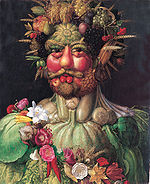
Vertumnus, Rudolph II Holy, Roman Emperor painted as the Roman God of the Seasons, 1590. 

The 16th Century Italian painter Giuseppe Arcimboldo is known as a sort of early Surrealist. His famous works include human heads made of fruit and vegetables and other objects.

So why pick a Surrealist painter to pay homage to? It is a deliberate writing choice by Bolano to have one of his main characters change his last name from Reiter to a deviated version of Arcimboldo ( Reiter changes his name to Archimboldi).

On one level, the now dead Bolano gives us a wink when he uses Arcimboldo,  suggesting that 2666 is surreal, not only in the many dreams and visions in the novel, but how we can read the novel like a dream.  And, on another level, Bolano may be giving us insight into the nature of what we take from novels ( or any story telling device, even dreams).  Rieter takes ideas from a notebook he finds and reads, such as this painter's name, and absorbs these ideas into his own life after altering them.

More about Arcimboldo

Although unrecognized as a great artist for many years since his death, the surrealists Dali and Magritte claimed Arcimboldo as one of their own, creating a place for him in art history.  Man Ray recreated Arcimboldo's "Winter" and Alfred Barr, the founding director of the Museum of Modern Art,  included Archimboldo in a 1936 show called "Fantasy in Art, Dada and Surrealism."

Arcimboldo's Winter
Man Ray was inspired by this painting (Seen below)

Magritte and Dali used objects for body parts, as seen here in a Magritte Suurealistic painting

Arcimboldo lived at a time when visual puns were highly regarded.  The Surrealist-type paintings of Arcimbaldo show 16th century tastes: naturalism and the grotesque, as in the reversible paintings that are still-life that become faces when the panels are flipped upside down. 

daVinci, Michelangelo and others like to make cartoon-like grotesques.  Here we see da Vinci's drawing.  Arcimboldo saw da Vinci's drawings. 


drawing of Arcimboldo

Arcimboldo was considered a respected artist in his day, and other paintings of his are more mundane, as when he documents plants and animals such as crabs, oysters and coral.

See a slide show of Arcimboldo's work here: http://www.nytimes.com/slideshow/2007/10/09/arts/20071010_ARCI_SLIDESHOW_index.html?ref=design


Sources: http://www.nytimes.com/2010/09/24/arts/design/24arcimboldo.html